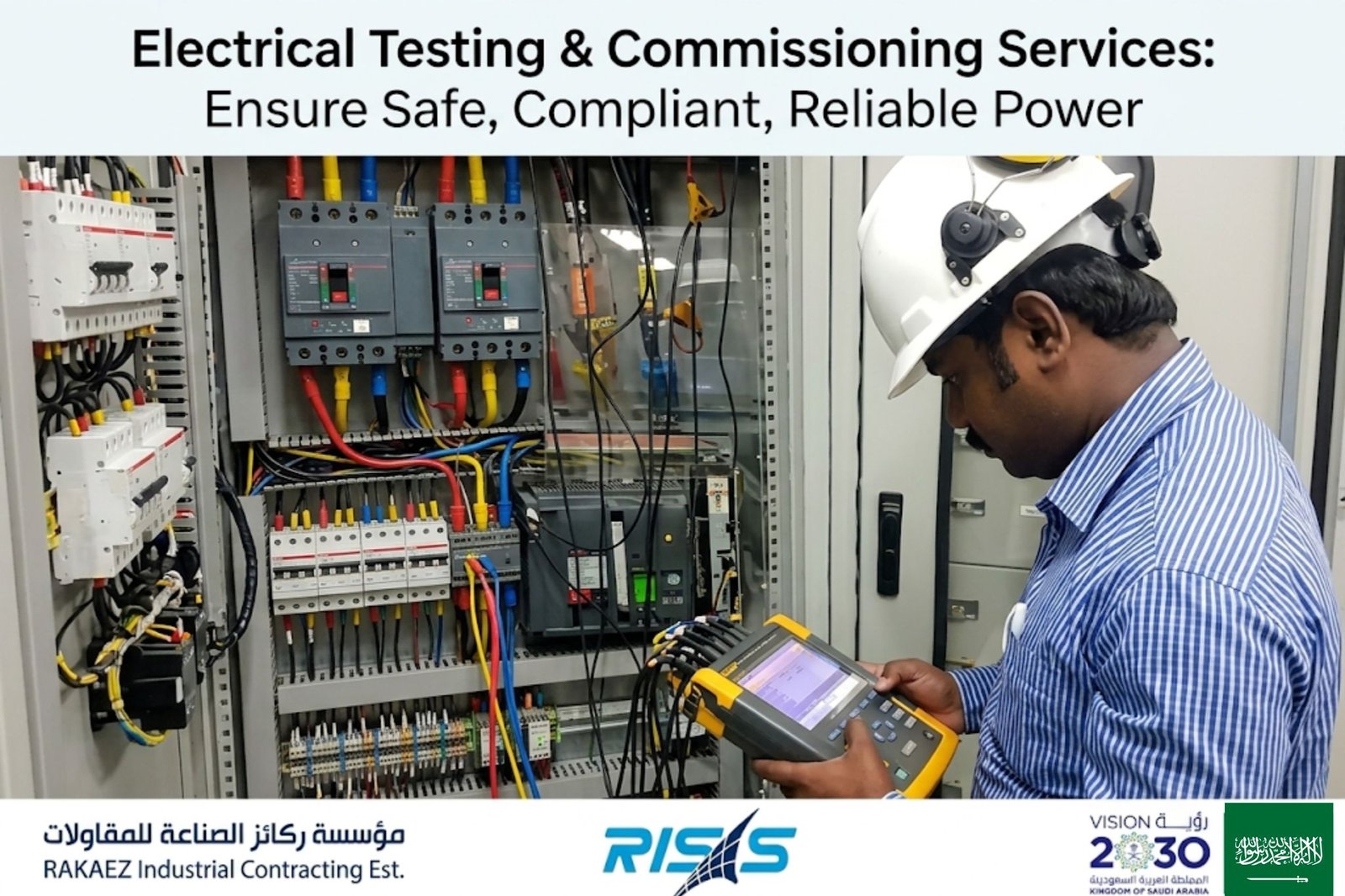
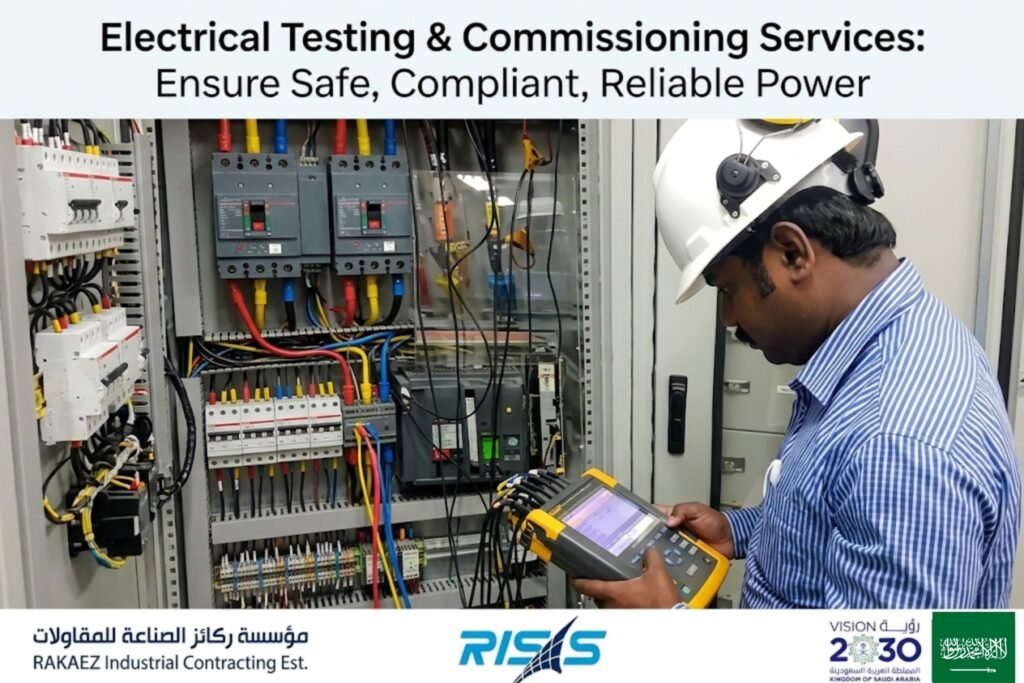
Introduction Electrical testing and commissioning are essential steps to verify that electrical systems meet design intent, operate safely, and deliver reliable performance. From new installations in commercial buildings and data centers to refurbishments in industrial plants and substations, professional testing and commissioning reduce risk, prevent costly failures, and provide documented proof of compliance.
What are Electrical Testing and Commissioning? Electrical testing comprises diagnostic and performance tests performed on components (cables, transformers, switchgear, motors, protection devices) to verify integrity and function. Commissioning is the systematic process of planning, executing, verifying, and documenting that systems and components are installed, tested, and operate according to the owner’s operational requirements and applicable standards.
Why It Matters
• Safety: Identifies faults that could cause electric shock, fire, or catastrophic equipment failure.
• Reliability: Verifies systems will carry expected loads, handle fault conditions, and maintain continuity of service.
• Compliance: Ensures adherence to national/local codes (NEC, local regulations) and international standards (IEC, IEEE).
• Cost control: Early detection of defects avoids expensive repairs, long downtime, and warranty disputes.
• Documentation: Provides traceable records for owners, insurers, and maintenance teams.
Core Electrical Testing Services
• Pre-commissioning inspections: Mechanical and visual checks to confirm correct installation before energization.
• Insulation resistance (megger) testing: Confirms insulation integrity for cables, motors, and transformer windings.
• Continuity and loop impedance testing: Ensures proper bonding, continuity and correct fault clearing by protective devices.
• Transformer testing: Turns ratio, winding resistance, excitation current, insulation power factor (tan delta) and oil testing when applicable.
• Circuit breaker testing: Timing, contact resistance, primary/secondary injection to verify performance under fault conditions.
• Relay and protection testing: Secondary injection and functional testing, protection coordination and setting verification.
• Motor and generator testing: Insulation, no-load/load tests, vibration and thermal assessments.
• Grounding/earthing tests: Soil resistivity, earth loop impedance and continuity to ensure effective fault dissipation.
• Cable diagnostics: Partial discharge, sheath testing, and VLF testing for long cable runs.
• Switchgear and MCC testing: Functional checks, interlocks, control wiring verification and safety interlocks.
• Site Acceptance Testing (SAT): System-level tests and load simulations confirming operational readiness.
Typical Commissioning Process
1. Planning and documentation: Develop a Commissioning Plan, test procedures, acceptance criteria and schedule with stakeholders.
2. Pre-energization checks: Confirm mechanical completion, torque checks, wiring, labeling and safety interlocks.
3. Energization and functional testing: Bring equipment online in a controlled sequence while validating functions.
4. Performance tests: Validate voltage regulation, load sharing, harmonics, and transient behavior under realistic conditions.
5. Protection verification: Confirm relay operation and coordination to protect personnel and assets.
6. Final handover: Deliver detailed test reports, as-built drawings, calibration certificates and maintenance recommendations.
Standards and Compliance, We execute testing and commissioning in accordance with relevant standards and best practices, including IEC and IEEE testing procedures, local electrical codes, and manufacturer commissioning requirements. Following standards reduces liability and ensures warranty and insurance conditions are met.
Industries We Serve
• Commercial buildings and high-rise developments
• Data centers and mission-critical facilities
• Manufacturing, process and food production plants
• Oil & gas and petrochemical installations
• Utilities and electrical substations
• Healthcare and laboratory facilities
• Renewable energy plants and microgrids
Common FAQ
Q: How long does commissioning take?
A: It depends on system complexity. Small commercial installations may take days; large plants or substations can take weeks. Timelines are provided during planning.
Q: Will testing require shutdowns?
A: Some tests require isolation or planned outages. We coordinate closely to minimize impact and can often perform non-disruptive checks during live operation.
Q: Do you issue compliance certificates?
A: Yes. We provide comprehensive test reports, certificates of compliance, and as-built documentation upon completion.
Q: Can you support emergency troubleshooting?
A: Yes. We offer rapid-response fault location, emergency testing and remedial services.
How to Prepare
• Provide design documents, single-line diagrams, and equipment manuals in advance.
• Ensure mechanical completion and that site permits and safety arrangements are in place.
• Coordinate outages, point-of-contact personnel and access.
• Confirm availability of load banks or simulated loads if required for performance testing.
Conclusion and Call to Action Investing in professional electrical testing and commissioning protects assets, people, and operations. Our certified engineers, proven procedures, and comprehensive reporting give you the confidence to commission systems safely and on schedule. Contact us today for a site assessment, tailored commissioning plan, and a competitive quote.
Contact RISAS today for expert consultation and customized vacuum solutions.
📞 +966 13 667 7533
📧 info@risas.sa
Viska Clanella
Rather than presenting commissioning as a final project milestone, the article demonstrates how planning, inspection, functional testing, protection coordination, and documentation collectively establish confidence in system performance. This integrated perspective reflects modern engineering practices where verification is considered just as important as design itself.