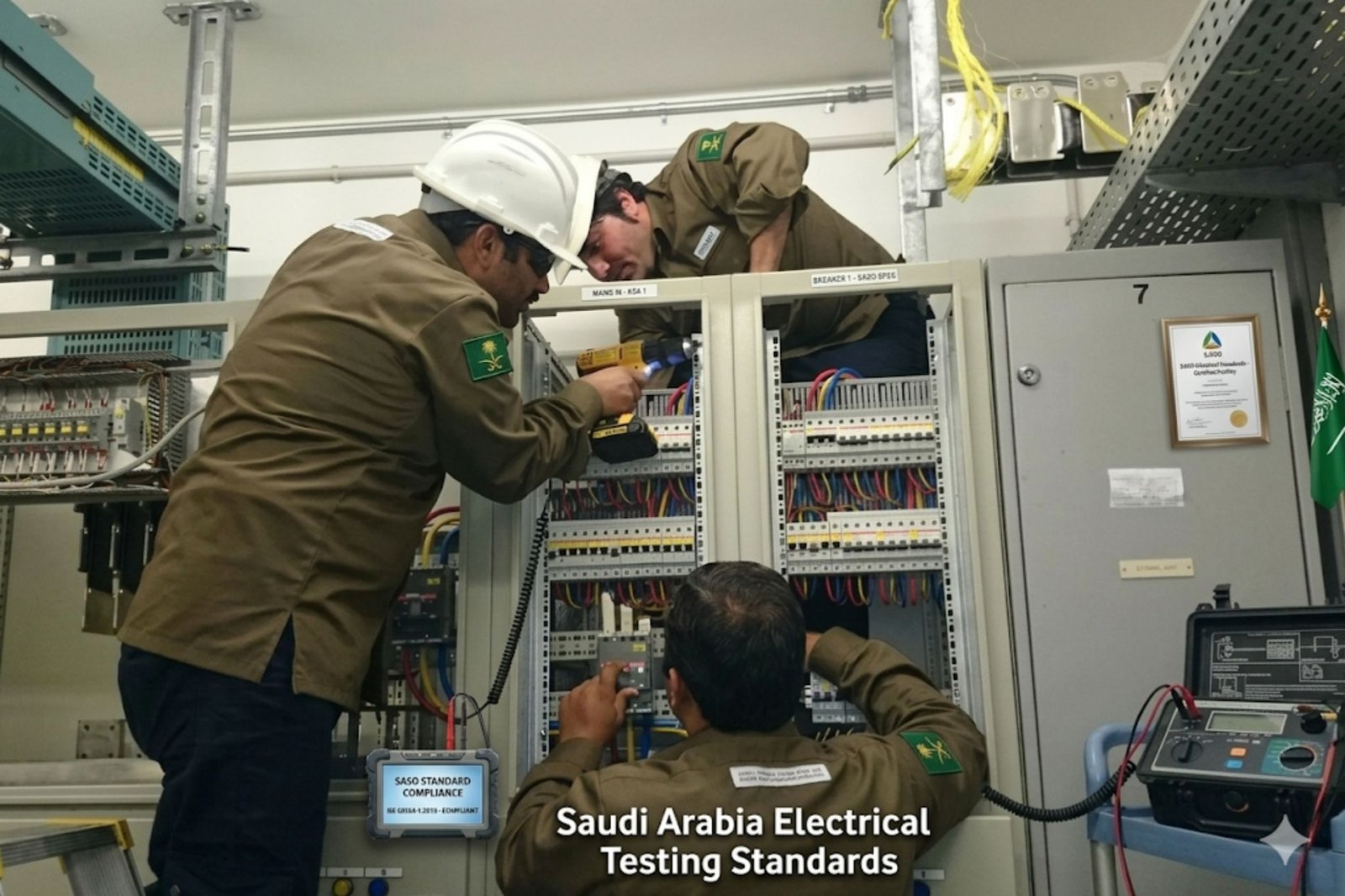
In Saudi Arabia, electrical testing and commissioning are governed primarily by the Saudi
Arabian Standards Organization (SASO) and the Saudi Building Code (SBC) , specifically
SBC 401 (Electrical Installations)
1. Regulatory Framework & Standards
The UK or US standards mentioned previously are used as references, but in Saudi Arabia, the
following take precedence:
● SBC 401: The National Standard for Electrical Installations, largely based on IEC 60364
but with local climate and voltage adaptations.
● SASO IEC Standards: Most electrical components must be SASO-certified to ensure
they can handle the high ambient temperatures and humidity levels of the region.
● Aramco (SAES) & SABIC (SES): For industrial projects, Engineering Standards like
SAES-P-111 (Grounding) and SAES-P-114 (Control Systems) dictate much more rigorous
commissioning protocols than commercial codes.
2. Specific Testing Requirements for the Region
Given the environmental conditions (heat, salt air, and sand), certain tests are prioritized:
● Contact Resistance Testing (Ductor Test): Crucial for switchgear and busbars to ensure
that thermal expansion and corrosion haven’t compromised high-current connections.
● Transformer Oil Analysis (DGA): For power transformers (MV/HV), Dissolved Gas
Analysis is a standard commissioning requirement to ensure no internal damage occurred
during shipping or installation.
● Relay Coordination & Protection Testing: Using secondary injection sets (like Omicron)
to verify that protection relays trip according to the specific settings approved by the local
utility (SEC) or the industrial facility.
● VLF (Very Low Frequency) Cable Testing: Used for medium-voltage cable
commissioning to identify insulation weaknesses without damaging the cable, which is
preferred over high-voltage DC Hipot tests in modern Saudi projects.
3. Equipment & Voltage Considerations
Saudi Arabia has transitioned to a unified voltage system, which must be reflected in testing:
● Standard Voltage: 230V / 400V at 60Hz.
● Earthing Systems: Most new installations follow the TN-S or TN-C-S earthing
arrangements. Testing must verify the “Earth Loop Impedance” specifically against these
configurations to ensure safety in the dry, high-resistivity soil common in the Eastern
Province.
4. The Saudi Commissioning Workflow (Typical Industrial)
FAT (Factory Acceptance Test): Often witnessed by Saudi-based inspectors at the
manufacturer’s facility before equipment is shipped.
SAT (Site Acceptance Test): Verification of equipment after arrival and installation to
ensure no transit damage.
Pre-Commissioning (Cold Commissioning): Testing without power (Continuity,
Insulation, Point-to-Point wiring checks).
Hot Commissioning: Energizing the system in stages, beginning with the Main Low
Voltage (MLV) panels and moving to downstream distribution.
SEC/Professional Engineering Approval: Final inspection and “Release for Operation”
(RFO) often requires a signature from a Saudi Council of Engineers (SCE) certified
professional.
5. Maintenance Intervals
Due to high dust (sandstorms) and extreme heat, the frequency of “Routine Maintenance” is
typically higher than in Europe or the US. Annual infrared thermography and bi-annual
cleaning/tightening of distribution boards are standard “Best Practices” in the Kingdom to
prevent arc-flash incidents caused by environmental degradation.