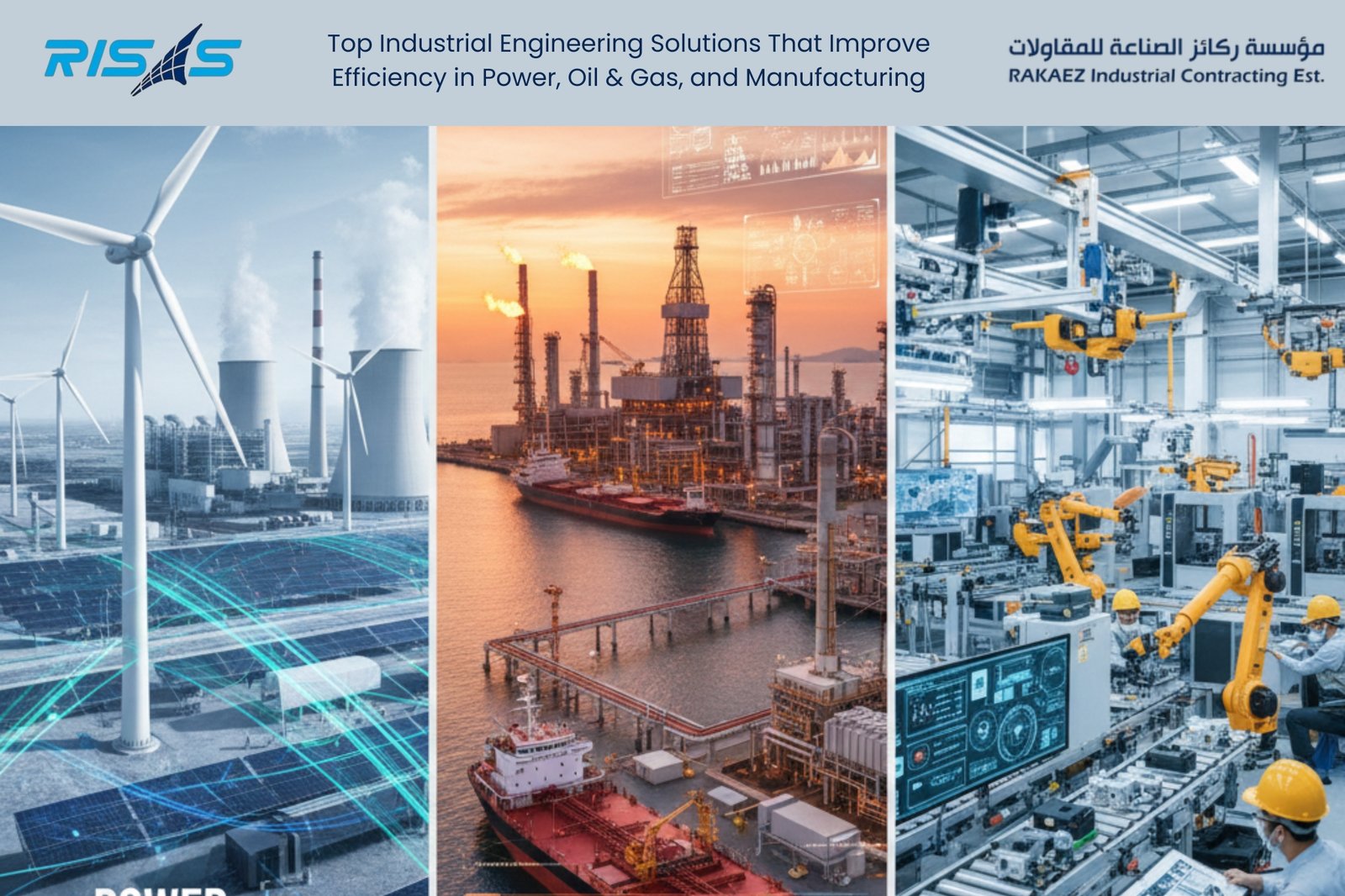
In today’s highly competitive industrial landscape, operational efficiency is no longer optional — it is essential. Power plants, oil & gas facilities, and manufacturing industries must continuously optimize processes, reduce downtime, and adopt smarter technologies to remain profitable and compliant with global standards.
Industrial engineering plays a central role in helping organizations achieve these goals by implementing innovative systems, automation, and data-driven strategies.
This blog explores the top industrial engineering solutions that significantly improve efficiency, reliability, and overall performance across the Power, Oil & Gas, and Manufacturing sectors.
1. Advanced Automation & Control Systems
Modern industries rely heavily on automation systems to enhance accuracy, reduce manual errors, and streamline production.
Key technologies include:
- PLC (Programmable Logic Controllers)
- SCADA (Supervisory Control and Data Acquisition)
- DCS (Distributed Control Systems)
- HMI (Human Machine Interfaces)
These systems enable real-time monitoring, improved decision-making, and automatic process adjustments, resulting in higher throughput and safer operations.
Benefits of automation:
- Consistent and precise operations
- Reduced human intervention
- Improved safety in hazardous environments
- Lower operational and maintenance costs
Oil refineries, power generation plants, and chemical processing facilities see some of the highest ROI when upgrading outdated control systems to modern, integrated automation.
2. Predictive Maintenance & Condition Monitoring
Traditional maintenance methods often rely on scheduled shutdowns or wait until failures occur — both of which can be costly.
Predictive maintenance, powered by smart sensors and diagnostic tools, allows industries to identify equipment issues before they cause downtime.
Common predictive technologies include:
- Vibration analysis
- Thermal imaging
- Ultrasonic testing
- Oil analysis
- IoT-linked sensor monitoring
Why predictive maintenance matters:
- Minimizes unexpected breakdowns
- Extends equipment life
- Improves asset reliability
- Reduces shutdown duration and maintenance costs
For high-value assets such as gas turbines, compressors, switchgear, transformers, and production machinery, predictive strategies can save industries millions annually.
3. Energy Optimization Solutions
Energy is one of the highest operational expenses in the industrial sector. Engineering-driven energy optimization solutions help reduce power consumption without affecting productivity.
High-impact methods include:
- Power Factor Correction Systems
- High-efficiency motors & drives
- Process heat recovery systems
- LED lighting retrofits for industrial environments
- Variable Speed Drives (VSDs)
Key benefits:
- Lower electricity bills
- Improved system efficiency
- Reduced carbon footprint
- Enhanced equipment performance
Power-intensive industries — especially steel plants, manufacturing facilities, and petrochemical operations — benefit greatly with substantial cost savings over time.
4. High-Performance Electrical Infrastructure Upgrades
Efficient electrical systems are the backbone of all industrial facilities. Aging equipment like MCC panels, switchgear, transformers, and cable networks often leads to voltage drops, losses, and inefficiencies.
Engineering upgrades may include:
- New MCC (Motor Control Centers)
- LV & MV switchgear modernization
- Transformer maintenance & replacement
- Busway and cable tray enhancements
- Reliable grounding and earthing systems
Results of upgrading electrical infrastructure:
- Improved load management
- Enhanced equipment protection
- Reduced failures and fire hazards
- Better compliance with international electrical standards
Power plants and oil & gas facilities particularly depend on high-quality electrical systems to maintain non-stop operations.
5. Engineering Improvements in Mechanical Systems
Mechanical equipment such as pumps, compressors, turbines, and heat exchangers are critical in almost every industrial sector.
Over time, inefficiencies build up due to wear, outdated technology, or inadequate maintenance.
Mechanical engineering solutions include:
- Pump and compressor performance optimization
- Mechanical seals and lubrication improvements
- Heat exchanger efficiency restoration
- Custom retrofitting and re-engineering
- Flow optimization and pressure balancing
Benefits:
- Reduced energy usage
- Lower operational costs
- Increased output and reliability
- Extended equipment lifespan
Oil & gas and chemical industries, in particular, experience significant efficiency gains through mechanical upgrades.
6. Instrumentation & Control System Enhancements
Instrumentation is the “nervous system” of industrial operations.
Accurate measurement and control ensure safe, consistent, and optimized production.
Key instrumentation solutions:
- Smart flow, temperature, pressure, and level transmitters
- Calibration services
- Analyzer systems for gas and liquid monitoring
- Custody metering systems for oil & gas
- Safety-integrated systems (SIS)
Efficiency benefits:
- Improved process accuracy
- Reduction in wastage
- Enhanced production consistency
- Stronger compliance with safety standards
Modern plants are increasingly adopting digital instrumentation that offers real-time data insights and predictive analytics.
7. Digital Transformation & Industrial IoT (IIoT)
Digitization is transforming industrial engineering through connectivity and data intelligence.
IIoT enables:
- Remote equipment monitoring
- Data-driven insights
- Predictive maintenance
- Automated alerts for operational anomalies
Key digital tools include:
- Cloud dashboards
- Smart sensors
- Digital twins
- AI-powered diagnostics
Digital transformation helps industries maximize output while maintaining safety and quality across processes.
8. Process Optimization & Value Engineering
Industrial engineering focuses not only on equipment but also on optimizing process workflows, reducing inefficiencies, and improving productivity through better design.
Process improvements may include:
- Workflow redesign
- Material flow improvement
- Bottleneck removal
- Lean manufacturing practices
- Value engineering analysis
Benefits:
- Higher throughput
- Reduced waste
- Improved operational consistency
- Lower costs without reducing performance
Manufacturing industries particularly gain substantial improvement from these engineering-focused process optimizations.
9. Safety Engineering & Compliance Solutions
Safety is a crucial part of industrial operations. Engineering controls help maintain compliance and reduce risk.
Key safety solutions:
- ATEX & explosion-proof systems
- Fire detection & suppression systems
- Electrical protection systems
- Hazardous area classification studies
- Emergency shutdown systems
These systems ensure safer workplaces and uninterrupted operations, especially in oil & gas and petrochemicals.
Conclusion: Engineering Solutions Are the Foundation of Industrial Efficiency
Whether in Power, Oil & Gas, or Manufacturing, industrial engineering provides the tools, technologies, and strategies needed to:
- Enhance operational efficiency
- Reduce downtime
- Improve safety and compliance
- Optimize energy use
- Increase output and reliability
Organizations that invest in advanced engineering solutions stay competitive, reduce costs, and ensure long-term sustainability.
GET IN TOUCH
Looking to improve efficiency in your facility?
RISAS specializes in engineering solutions tailored for industrial sectors across Saudi Arabia and the GCC.
📞 Contact us today: +966 13 667 7533
📧 Email: info@risas.sa