
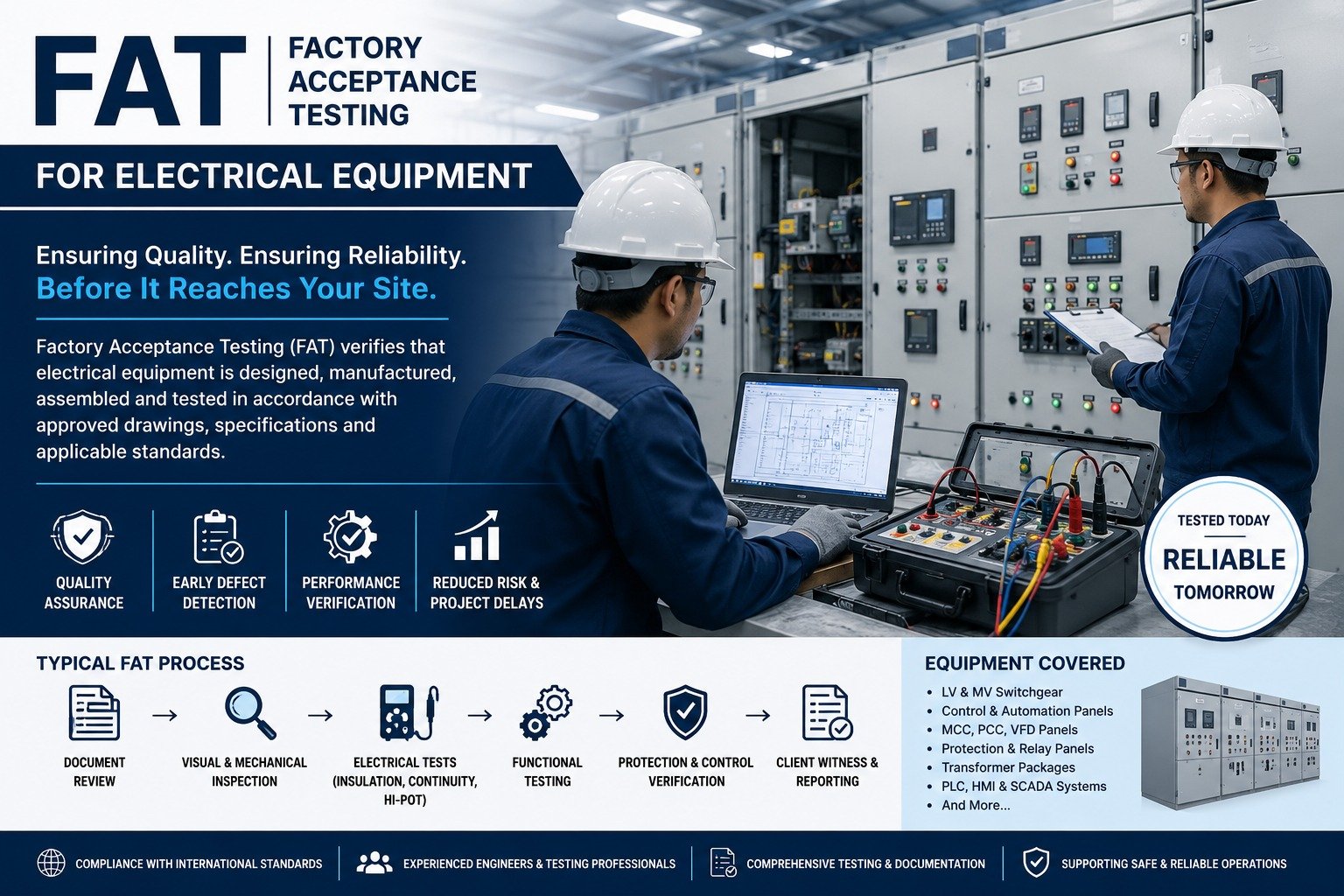
Factory Acceptance Testing (FAT) is a critical quality assurance and inspection process performed before electrical equipment is delivered to a project site. It verifies that equipment has been manufactured, assembled, wired, configured, and tested in accordance with approved drawings, technical specifications, applicable standards, and project requirements.
For industrial, commercial, infrastructure, oil and gas, and utility projects, effective FAT can identify problems before equipment is shipped. This helps reduce costly site modifications, commissioning delays, rework, and unexpected equipment failures.
Professional electrical FAT testing provides project owners, consultants, EPC contractors, and end users with greater confidence that equipment is ready for installation and commissioning.
What Is Factory Acceptance Testing (FAT)?
Factory Acceptance Testing is a structured inspection and testing process carried out at the manufacturer’s or equipment supplier’s facility before shipment.
During FAT, inspectors and project representatives verify the equipment’s:
- Construction and workmanship
- Electrical characteristics
- Wiring and termination
- Protection functions
- Control functions
- Interlocks and alarms
- Communication systems
- Functional performance
- Compliance with approved documentation
The exact FAT scope depends on the equipment type, project specifications, approved Inspection & Test Plan (ITP), manufacturer documentation, and applicable standards.
Why Is FAT Important for Electrical Equipment?
Electrical equipment problems discovered after delivery can result in expensive site modifications and significant project delays. FAT provides an opportunity to identify and resolve issues while the equipment is still at the manufacturer’s facility.
Key Benefits of Factory Acceptance Testing
A properly planned FAT can help with:
- Early detection of manufacturing defects
- Verification of compliance with approved specifications
- Confirmation of electrical and functional performance
- Verification of wiring and control circuits
- Identification of incorrect components or configurations
- Reduction of installation and commissioning problems
- Reduction of costly site rework
- Improved equipment reliability
- Better project quality assurance
- Improved readiness for site installation and commissioning
FAT is particularly valuable for complex electrical systems where correcting wiring, protection, PLC logic, or control problems after installation can be time-consuming and expensive.
Electrical Equipment Covered by FAT
Factory Acceptance Testing can be performed on a wide range of electrical, automation, and control equipment.
Common equipment includes:
- LV Switchgear
- MV Switchgear
- Electrical Distribution Panels
- MCC (Motor Control Center) Panels
- PCC (Power Control Center) Panels
- VFD Panels
- Soft Starter Panels
- PLC and Automation Panels
- Protection and Relay Panels
- Transformer Packages
- ATS/AMF Panels
- UPS Systems
- Battery Systems
- Control Panels
- SCADA and Communication Systems
The testing requirements vary according to the equipment’s function, voltage level, configuration, and project specifications.
Typical Factory Acceptance Testing Activities
The FAT procedure should be developed around the approved project documentation and equipment-specific requirements.
Typical activities include the following.
1. FAT Document and Drawing Review
Before physical testing begins, relevant technical documents are reviewed to establish the inspection and testing requirements.
Documents may include:
- Approved drawings
- Single-line diagrams
- General arrangement drawings
- Wiring and schematic diagrams
- Equipment datasheets
- Technical specifications
- Bill of Materials (BOM)
- Component lists
- Protection settings
- Control philosophy
- FAT procedure
- Inspection & Test Plan (ITP)
- Applicable standards
- Previous inspection records, where applicable
Document review helps ensure that the equipment being tested matches the approved project design.
2. Visual and Mechanical Inspection
A detailed visual and mechanical inspection is performed to verify equipment construction and workmanship.
Typical inspection points include:
- Enclosure dimensions and construction
- Equipment identification and nameplates
- Component ratings and specifications
- Busbar arrangement
- Cable termination
- Internal wiring
- Earthing connections
- Labels and ferrules
- Terminal blocks
- Circuit breakers and contactors
- Mechanical interlocks
- Door and panel operation
- Ventilation arrangements
- Equipment cleanliness
- General workmanship
This inspection can identify physical or assembly-related issues before the equipment is transported to site.
3. Electrical Testing
Electrical tests are selected according to the equipment type and applicable project requirements.
Depending on the equipment, FAT may include:
- Insulation resistance testing
- Continuity testing
- Earth continuity testing
- Dielectric withstand / Hi-Pot testing
- Wiring verification
- Phase identification
- Control circuit verification
- Auxiliary circuit testing
- Measurement and metering verification
All testing should be conducted using appropriate, calibrated test equipment and approved procedures.
4. Protection and Relay Testing
For switchgear, protection panels, and other systems incorporating protective relays, protection functions are an important part of FAT.
Testing may include:
- Protection relay configuration verification
- Relay settings verification
- Trip circuit testing
- Alarm verification
- Breaker trip and close functions
- Protection logic
- Interlocks
- Indications
- Auxiliary contacts
- Trip circuit supervision
- Communication and monitoring functions
Where required, secondary injection testing may be performed to verify relay operation against specified settings and functional requirements.
5. Functional and Control Testing
Functional testing verifies that the equipment operates according to the approved control philosophy and project requirements.
Depending on the system, FAT may include verification of:
- Start/stop commands
- Local and remote operation
- Automatic and manual modes
- Breaker operation
- Motor control functions
- Interlocks
- Permissives
- Alarms
- Trips
- Emergency shutdown functions
- Sequence logic
- Control circuits
- Status indications
Functional testing is particularly important for complex MCC, PCC, PLC, automation, and control systems.
6. PLC, HMI, and SCADA Testing
For automation systems, FAT provides an opportunity to test software and control functionality before equipment is installed at site.
Testing may include:
- PLC input and output verification
- PLC logic testing
- HMI screen verification
- Alarm functionality
- Equipment status indications
- Control commands
- Interlocks and permissives
- Communication signals
- Data mapping
- Remote control functionality
- SCADA interface verification
Testing these functions at the factory can significantly reduce troubleshooting requirements during site commissioning.
7. FAT Documentation and Reporting
Proper documentation is an essential part of the FAT process.
Typical FAT documentation includes:
- Approved FAT procedure
- Inspection and Test Plan
- Test results
- Inspection checklists
- Calibration certificates
- Equipment datasheets
- Test instrument details
- Protection relay test results
- Functional test records
- Punch-list items
- Non-conformance records, where applicable
- Photographic records, where required
- Final FAT report
A complete FAT report provides documented evidence that the agreed inspection and testing activities were completed.
FAT Procedure: Step-by-Step Process
A typical Factory Acceptance Testing process follows a structured sequence.
Step 1: Review Project Requirements
Review specifications, drawings, datasheets, approved vendor documents, ITPs, and applicable standards.
Step 2: Prepare the FAT Procedure
Define the inspection points, test methods, acceptance criteria, required instruments, responsibilities, and documentation.
Step 3: Conduct Visual and Mechanical Inspection
Verify equipment construction, components, labels, wiring, dimensions, and workmanship.
Step 4: Perform Electrical Tests
Carry out applicable insulation, continuity, dielectric withstand, wiring, and other electrical tests.
Step 5: Test Protection and Control Functions
Verify protection settings, trips, alarms, interlocks, control circuits, and functional logic.
Step 6: Perform Functional Testing
Operate the equipment under defined test conditions and verify the required sequences and responses.
Step 7: Record Findings
Document test results, deviations, observations, punch-list items, and non-conformities.
Step 8: Close FAT
Resolve outstanding issues where possible and issue the final FAT documentation before equipment shipment.
FAT vs. SAT: What Is the Difference?
FAT (Factory Acceptance Testing) and SAT (Site Acceptance Testing) are complementary quality assurance activities.
| FAT | SAT |
|---|---|
| Performed at the manufacturer’s facility | Performed at the project site |
| Conducted before shipment | Conducted after installation |
| Verifies manufacturing and equipment functionality | Verifies installation and site functionality |
| Identifies factory-level defects | Identifies installation or site-related issues |
| Uses factory test conditions | Uses actual site conditions |
| Reduces commissioning risks | Confirms readiness for operation |
FAT
FAT confirms that the equipment has been manufactured and tested according to approved requirements before it leaves the factory.
SAT
SAT verifies that the equipment has been correctly installed, connected, integrated, and commissioned under actual project site conditions.
FAT does not replace SAT. Both tests can be important for complex electrical installations.
Common FAT Issues Found During Electrical Equipment Inspection
FAT can uncover a wide range of issues before equipment reaches the site.
Examples include:
- Incorrect component ratings
- Wiring errors
- Incorrect terminal connections
- Missing labels
- Incorrect relay settings
- Faulty interlocks
- Incorrect PLC logic
- Communication problems
- Incorrect breaker operation
- Missing or incomplete documentation
- Inadequate earthing connections
- Mechanical alignment problems
- Incorrect panel configuration
- Non-compliance with approved drawings
Finding these issues at the factory is generally more efficient than discovering them during installation or commissioning.
Factory Acceptance Testing Services in Saudi Arabia
Professional FAT inspection and testing services in Saudi Arabia can help project owners, EPC contractors, consultants, and equipment suppliers verify electrical equipment before shipment.
FAT support can include:
- FAT procedure review
- ITP review
- Technical document review
- Visual and mechanical inspection
- Electrical testing
- Insulation resistance testing
- Continuity testing
- Dielectric withstand testing
- Protection relay testing
- Functional testing
- PLC and HMI testing
- Interlock verification
- Control circuit testing
- Communication testing
- FAT witnessing
- Punch-list identification
- Non-conformance identification
- FAT report preparation and review
An independent FAT inspection can provide an additional level of quality assurance between the equipment manufacturer and the project owner or end user.
Why Use Independent FAT Inspection?
For major electrical projects, independent inspection can provide an objective assessment of equipment quality and compliance.
Independent FAT inspection can help project stakeholders:
- Verify compliance with approved documentation
- Identify deviations before shipment
- Witness critical tests
- Confirm test results
- Review calibration documentation
- Record outstanding punch-list items
- Improve equipment quality assurance
- Reduce commissioning risks
This is particularly valuable for critical electrical equipment and long-lead items, where site replacement or modification can have a major impact on project schedules and costs.
Best Practices for Effective FAT
To make FAT more effective, project teams should:
- Define the FAT scope early in the project.
- Use approved drawings and technical specifications as the basis for inspection.
- Prepare a detailed FAT procedure and ITP.
- Define clear acceptance criteria before testing begins.
- Ensure all test instruments are properly calibrated.
- Include representatives from relevant project stakeholders where required.
- Document all test results and observations.
- Record deviations and punch-list items clearly.
- Verify corrective actions before shipment.
- Maintain complete FAT documentation for project records.
A well-planned FAT should focus not only on whether equipment powers up, but also on whether it meets the approved design, performs its intended functions, and is ready for safe installation and commissioning.
Conclusion
Factory Acceptance Testing (FAT) for electrical equipment is an important quality assurance step in industrial, commercial, infrastructure, utility, and other electrical projects.
By inspecting equipment construction and verifying electrical, protection, control, communication, and functional performance before shipment, FAT helps identify problems at the manufacturing stage rather than during site installation or commissioning.
Effective FAT can help:
- Reduce site rework
- Minimize commissioning delays
- Identify manufacturing defects early
- Verify compliance with project requirements
- Improve equipment reliability
- Reduce technical and project risks
- Improve overall project quality
From LV and MV switchgear to MCCs, PCCs, PLC panels, protection systems, transformers, UPS systems, and automation equipment, professional FAT inspection provides valuable assurance that electrical equipment is ready for the next stage of the project.
Need professional Factory Acceptance Testing or FAT inspection support in Saudi Arabia? Contact our engineering team to discuss your electrical equipment and project requirements.
Frequently Asked Questions About FAT
What is Factory Acceptance Testing?
Factory Acceptance Testing (FAT) is a structured inspection and testing process performed at a manufacturer’s facility before electrical equipment is delivered to the project site. It verifies construction, electrical performance, control functions, protection, and compliance with approved project requirements.
Why is FAT required for electrical equipment?
FAT helps identify manufacturing, wiring, configuration, protection, and functional problems before equipment is shipped. Early identification can reduce site rework, commissioning delays, and project risks.
What equipment can be tested during FAT?
FAT can be performed on equipment such as LV and MV switchgear, MCC and PCC panels, distribution boards, VFD panels, PLC panels, protection panels, transformers, UPS systems, ATS/AMF panels, and control and SCADA systems.
What tests are performed during FAT?
The FAT scope varies by equipment. Typical tests include visual inspection, mechanical inspection, insulation resistance, continuity, dielectric withstand testing, wiring verification, functional testing, protection relay testing, interlock testing, PLC testing, HMI testing, and communication testing.
What is the difference between FAT and SAT?
FAT is performed at the manufacturer’s facility before shipment and focuses on equipment manufacturing and functionality. SAT is performed at the project site after installation and verifies installation, integration, and operation under actual site conditions.
Who should attend a FAT?
Depending on the project, FAT may be witnessed by the equipment manufacturer, client or owner representatives, consultant, EPC contractor, third-party inspector, and other relevant stakeholders.
Does FAT replace site commissioning?
No. FAT and site commissioning serve different purposes. FAT verifies equipment before shipment, while commissioning and SAT verify installation, integration, and operation at the project site.
How can FAT reduce project costs?
FAT can identify problems before equipment is shipped, when corrections are generally easier and less disruptive. Resolving issues at the factory can reduce site modifications, commissioning delays, troubleshooting, and potential project downtime.