In the rapidly expanding industrial landscape of the Eastern Province , from the refineries of
Jubail to the power hubs of Dammam , the reliability of electrical infrastructure is the
backbone of operational success. Whether you are transitioning a facility or overseeing a new
insta lation, understanding the nuances of electrical testing and commissioning is
non-negotiable for safety and compliance.
This guide explores the essential phases of commissioning, tailored specifica ly to the
standards of the Saudi Building Code (SBC) and the rigorous demands of the Kingdom’s
industrial sector.
standards of the Saudi Building Code (SBC) and the rigorous demands of the Kingdom’s
industrial sector.
What is Electrical Testing and Commissioning?
While often grouped together, these are two distinct phases of a project’s lifecycle:
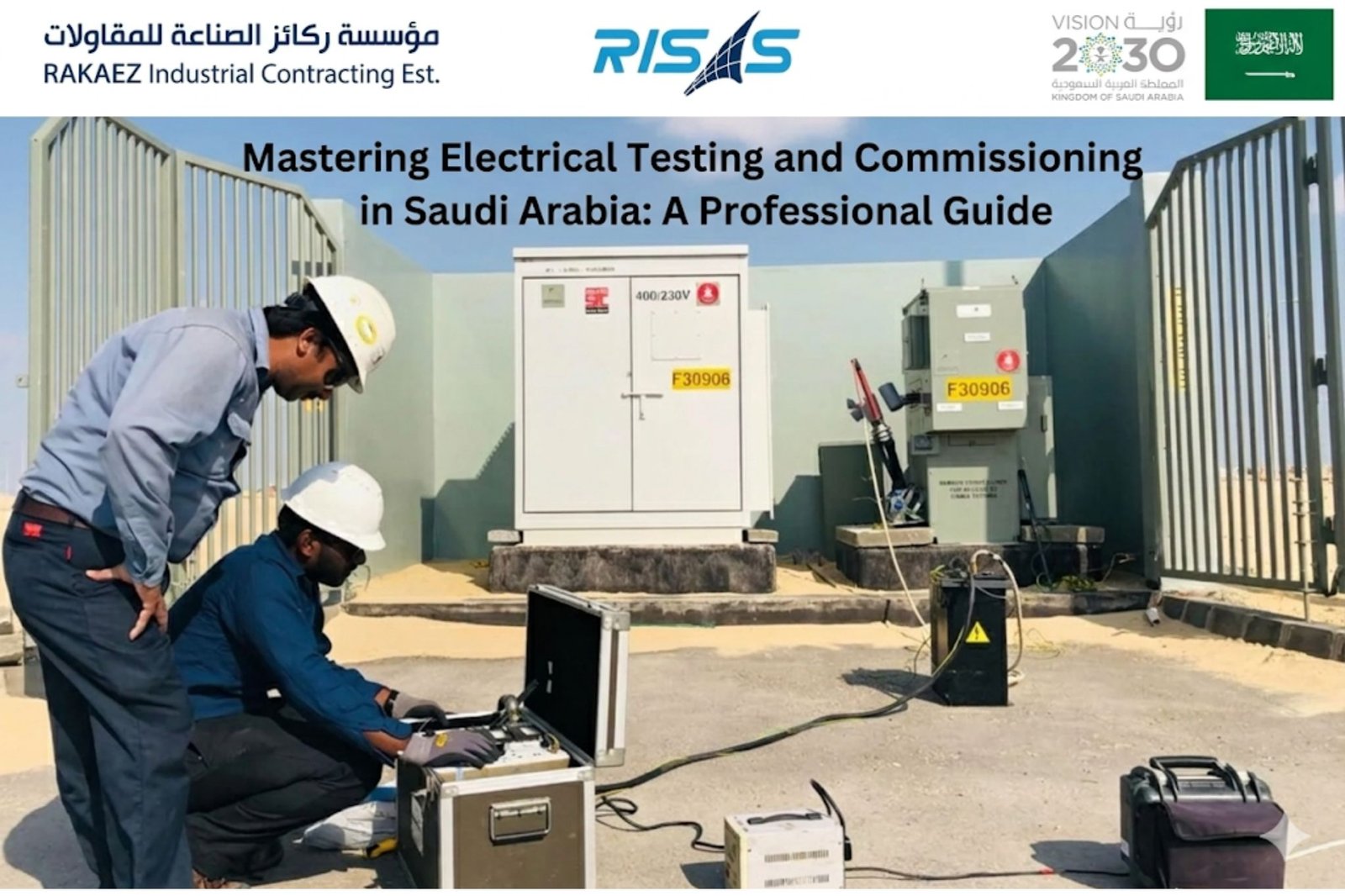
● Electrical Testing: The technical procedure of using specialized instruments to verify
that individual components—like transformers, switchgear, and cables—meet their
design specifications.
● Commissioning: The integrated process of ensuring that al these components work
together as a unified system, according to the owner’s requirements and the SBC 401
standards.
The 4 Essential Pillars of Electrical Testing
To ensure a system is “ready for power,” Saudi Arabian contractors typically prioritize these four
critical tests:
- Insulation Resistance (IR) Testing: Often called “Meggering,” this checks for leaks in
cable insulation. In the high-humidity environments of the Arabian Gulf, ensuring
insulation hasn’t degraded during storage or insta lation is vital. - Contact Resistance (Ductor) Testing: This measures the resistance of physical
connections in high-current breakers and busbars. Even a slightly loose bolt can lead to a
catastrophic “hot spot” in the desert heat. - Earth Loop Impedance & Grounding: Given the high resistivity of Saudi soil, verifying
the grounding system (earthing) is critical to ensure protective devices trip instantly
during a fault. - Protection Relay Coordination: Using secondary injection sets to simulate faults and
ensure that Low Voltage (LV) and Medium Voltage (MV) breakers trip in the correct
sequence, preventing site-wide blackouts.
The Commissioning Workflow: From FAT to RFO
A professional commissioning sequence in Saudi Arabia follows a strict hierarchy to mitigate risk:
| Phase | Description | Key Objective |
|---|---|---|
| FAT | Factory Acceptance Test | Verifying equipment at the manufacturer before shipping. |
| SAT | Site Acceptance Test | Checking for transit damage and correct installation on-site. |
| Cold Commissioning | De-energized Testing | Continuity, polarity, and point-to-point wiring checks. |
| Hot Commissioning | Live System Testing | Functional checks of control logic and load testing. |
| RFO | Release for Operation | Final documentation and handover to the facility manager. |
Regulatory Compliance: SBC 401 and Beyond
In Saudi Arabia, commissioning isn’t just a best practice—it’s a regulatory requirement. All new
installations must align with:
● SBC 401 (Electrical Requirements): The primary code governing electrical safety in the
Kingdom.
● SASO Standards: Ensuring all imported equipment is certified for the local 60Hz
frequency and 230V/400V voltage levels.
● SCE Certification: Final reports often require the stamp of a professional engineer
registered with the Saudi Council of Engineers.